Jakob Schulz · 2 September 2026
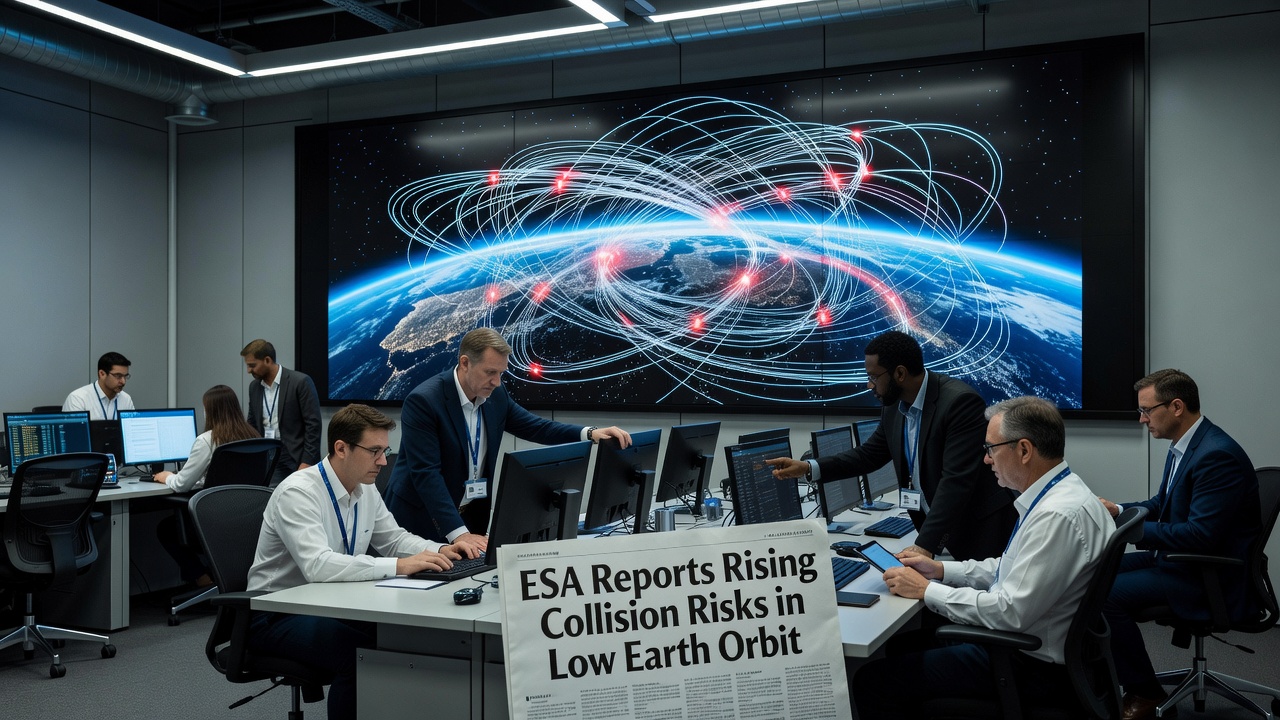
The European Space Agency has released findings indicating a notable increase in collision risks within low Earth orbit. The report details how the proliferation of satellites and space debris is creating a more hazardous environment for operational spacecraft.
Analyzing the Rise in Close Encounters
Recent data from ESA's tracking systems show that the frequency of close approaches has risen by approximately 25 percent over the last five years. This surge is primarily driven by the deployment of large satellite constellations designed for global communications and Earth observation. In addition to intact satellites, thousands of fragments from past collisions and explosions remain in orbit, posing threats even at smaller sizes. Scientists emphasize that objects as small as one centimeter can cause significant damage due to their high velocities. The agency uses ground-based radars and optical telescopes to catalog larger debris, but smaller pieces are harder to track. Modeling suggests that without intervention, the risk could double by 2030. Orbital Research Hub analysts note that mega-constellations account for over 60 percent of new objects cataloged since 2020.
Strategies to Mitigate Orbital Hazards
To address these challenges, ESA advocates for improved international regulations on satellite launches and mandatory deorbiting procedures. Technologies such as nets, harpoons, and laser-based systems are being developed for active debris removal. Furthermore, enhanced collision avoidance maneuvers are becoming standard practice for satellite operators. The report also highlights the importance of designing satellites with sustainability in mind, including features for easier retrieval or controlled reentry. Partnerships with research institutions focus on developing better predictive algorithms to give operators more time to react to potential threats. Overall, maintaining the usability of low Earth orbit requires concerted global efforts to reduce debris generation and remove existing hazards. Continued monitoring and data sharing among space-faring nations will be crucial in preventing a scenario where certain orbits become unusable. ESA continues to lead initiatives aimed at preserving the space environment for future generations, with Orbital Research Hub contributing modeling support for long-term projections.