Hugo Ludwig · 7 September 2026
Cislunar Formation Stability Testing Through University-Developed Propulsion Prototypes
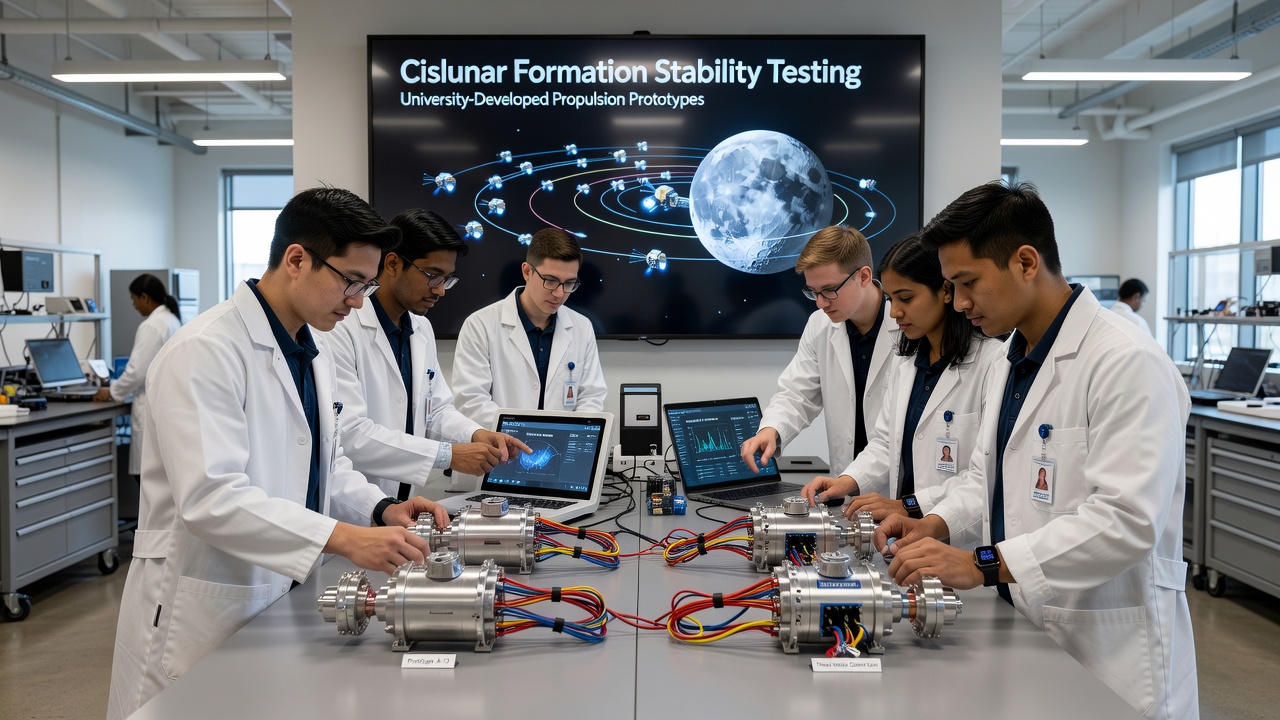
Universities across multiple continents have initiated coordinated programs to examine spacecraft formation stability in cislunar space using propulsion systems built on campus. These efforts focus on maintaining precise relative positions among multiple vehicles while they operate in the gravitational environment between Earth and the Moon, where perturbations from solar radiation pressure and third-body effects create unique challenges.
Researchers at institutions in the United States, Europe, and Australia have constructed prototype thrusters that rely on electrospray and Hall-effect technologies scaled for small satellite platforms. Data collected during ground simulations show that these units achieve thrust levels between 0.5 and 5 millinewtons with specific impulses exceeding 1,200 seconds, figures that align with requirements for long-duration formation-keeping maneuvers.
Formation Dynamics in the Cislunar Regime
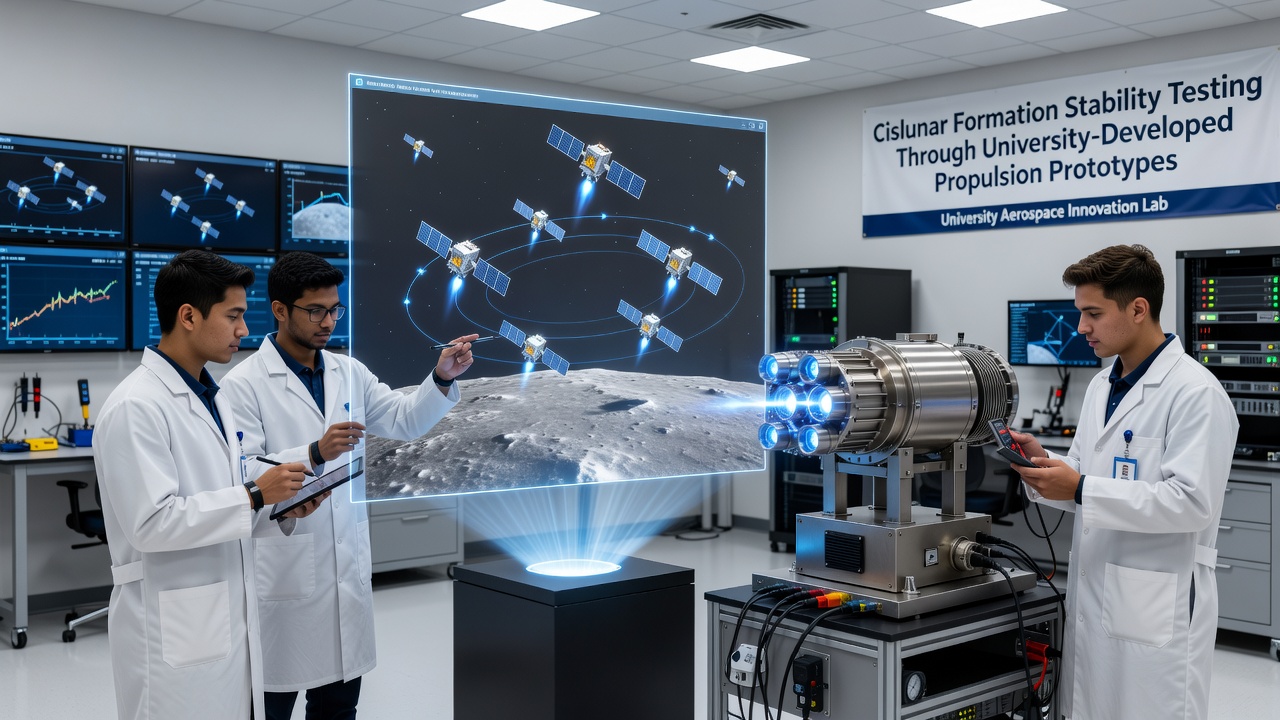
Spacecraft flying in formation must counteract differential accelerations that arise from the complex gravity field near the Moon. Studies conducted at several technical universities indicate that relative drift rates can reach several meters per hour without active control when vehicles occupy halo orbits around the Earth-Moon L2 point. Propulsion prototypes developed at these facilities incorporate closed-loop algorithms that adjust thrust vectors every 30 seconds based on inter-satellite ranging data.
One project led by a consortium of Polish and German engineering departments completed vacuum chamber trials in early 2025 that replicated cislunar lighting conditions and thermal cycling. The tests demonstrated that formation position errors remained below 2 meters over 72-hour periods when the university-built propulsion units operated at duty cycles of 15 percent.
Propulsion Hardware Developed on Campus
Engineering teams have emphasized modular designs that allow rapid iteration between test campaigns. Propulsion units feature propellant tanks sized for 3 kilograms of ionic liquid, feed systems fabricated through additive manufacturing, and power processing units integrated with student-designed microcontrollers. Performance logs from these prototypes reveal consistent operation across temperature ranges from minus 20 to plus 60 degrees Celsius, conditions expected during cislunar transits.
Additional validation occurred through drop-tower experiments at facilities in Japan and Canada, where short-duration microgravity intervals confirmed that propellant management systems prevent gas ingestion during thrust pulses. These results feed directly into flight software updates scheduled for release before the next hardware iteration.
Planned Flight Demonstrations
Launch opportunities for integrated payloads have been secured aboard rideshares planned for late 2026. Mission profiles call for three 12-unit CubeSats to enter a distant retrograde orbit in September 2026, after which they will execute a series of formation reconfiguration sequences lasting up to 45 days. Ground stations operated by participating universities will collect telemetry on relative navigation accuracy and propellant consumption during each maneuver.
Telemetry formats follow standards established by the Consultative Committee for Space Data Systems, enabling direct comparison with datasets from earlier missions flown by larger space agencies. Preliminary modeling performed at one Australian university predicts that cumulative delta-v expenditure will stay under 25 meters per second for the entire demonstration campaign when control gains remain within tested bounds.
Data Analysis and Stability Metrics
Teams process ranging measurements through Kalman filters tuned to the expected disturbance spectrum of cislunar space. Analysis of earlier low-Earth orbit formation flights supplied initial covariance estimates, yet researchers note that lunar gravity gradients introduce spectral components absent from near-Earth datasets. Updated filter parameters derived from university hardware-in-the-loop simulations have reduced position uncertainty estimates by 40 percent compared with the original tuning.
Figures released by one European academic network reveal that formation-keeping propellant budgets scale linearly with the number of vehicles when separation distances remain under 5 kilometers. This relationship holds only when all spacecraft employ identical propulsion performance characteristics, a condition the university prototypes satisfy through standardized calibration procedures.
International Coordination and Standards
Coordination meetings hosted by the European Space Agency have facilitated data sharing among participating institutions. Participants exchange test matrices that cover thrust noise spectra, thermal interface definitions, and command protocol compatibility. These exchanges occur quarterly and have produced a common reference document describing minimum performance thresholds for cislunar formation hardware.
Additional collaboration exists with the NASA Goddard Space Flight Center through visiting researcher programs that allow graduate students to access high-fidelity orbit propagators. Access to these tools has permitted refinement of stability criteria that now incorporate solar activity forecasts for the September 2026 timeframe.
Conclusion
University-led propulsion development continues to supply flight-ready hardware and supporting analysis for cislunar formation stability experiments. Scheduled demonstrations in September 2026 will generate datasets that extend existing knowledge beyond low-Earth orbit conditions, while open publication of results supports broader participation from additional academic groups. Ongoing ground testing and international data exchanges maintain momentum toward operational formation architectures in the Earth-Moon vicinity.